

Education
Do Cannabis Fruit and Dessert Names Describe Ingredients?
· BUDDHA BROS
A cannabis name containing a fruit, dessert or mint reference is not an ingredient list. It also does not establish ancestry, cannabinoid content or a particular effect. Candy Chrome, Gelato Mintz and Rainbow Guava are examples of names appearing in our catalogue and search data. The examples below explain the limits of names, rather than authenticate any particular batch.
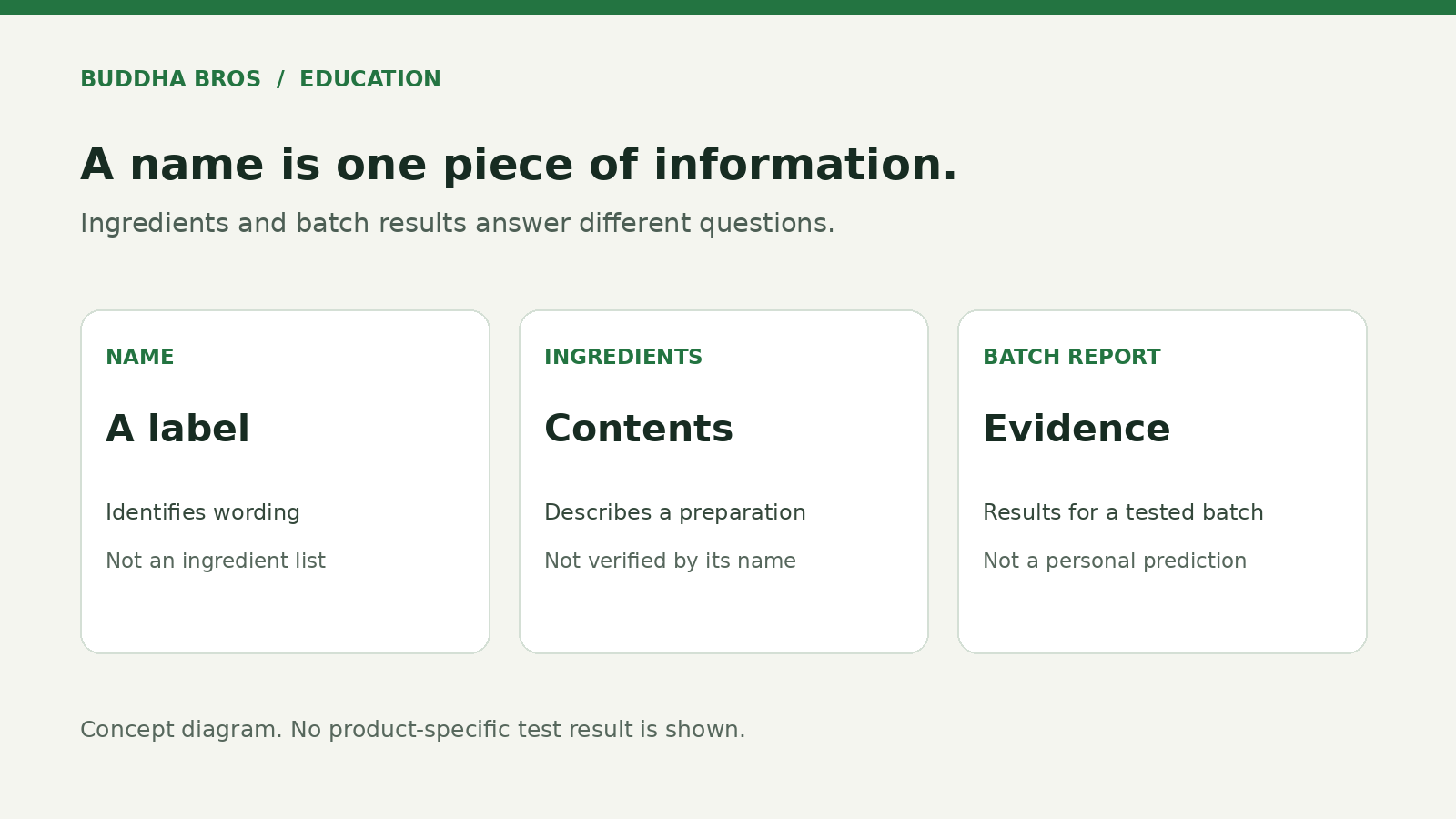
Does a fruit or dessert name prove that an ingredient was added?
No. A name alone does not document ingredients. Read the actual ingredient information for a manufactured preparation rather than inferring a recipe from a name. California's manufactured-product checklist treats product identity and ingredient listing as separate information. This distinction is especially useful when a familiar food word appears on a non-food item.
Sources: California DCC: Product identity and ingredient labeling
Does Candy Chrome or Candy Chromes identify one verified lineage?
The spelling alone cannot settle that question. Our catalogue uses Candy Chromes, while search data includes Candy Chrome. That is evidence of different wording, not proof that every use identifies the same genetic line. Verifying an origin would require a documented breeder account and a traceable connection to the material being described; neither is established by spelling.
Sources: Smith and colleagues (2022): The phytochemical diversity of commercial Cannabis in the United States
Does Gelato Mintz prove a mint ingredient or a particular Gelato parent?
Neither inference follows from the name alone. A word can suggest an association without documenting an ingredient or a breeding history. No authenticated breeder record or batch documentation for this catalogue entry was available for this article. For that reason, this guide does not assign parents, an indica-sativa percentage or a THC value to Gelato Mintz.
Sources: Smith and colleagues (2022): The phytochemical diversity of commercial Cannabis in the United States · California DCC: Product identity and ingredient labeling
Does Rainbow Guava establish fruit content or a measured aroma?
No. The name is not a chemical analysis. Health Canada explains that terpenes contribute to cannabis aroma, but the word guava does not establish which compounds are present or their measured amounts. A descriptive name and a laboratory result answer different questions. This article does not claim that this specific entry contains guava ingredients or a particular terpene profile.
What does research say about consistency between names and chemistry?
A 2022 PLOS ONE study compared commercial cannabis chemistry with labels across six US states. The researchers found that labels did not consistently describe the measured chemical diversity, although some names had stronger associations with particular profiles. That supports caution about treating a name as a chemical specification. It does not prove that all names are meaningless or directly authenticate these three examples.
Sources: Smith and colleagues (2022): The phytochemical diversity of commercial Cannabis in the United States
What evidence is more useful than the name for understanding a batch?
The package's identity, ingredient information where applicable, and matching batch report address different parts of that question. California's testing guidance describes a certificate of analysis as the record of results for a tested batch. Cannabinoid and contaminant findings are more specific than a name, but a report should not be borrowed from a different batch or treated as a promise of personal safety.
Sources: California DCC: Testing laboratories and certificates of analysis
Can a sweet-sounding name establish mild effects or a health benefit?
No. The wording is not clinical evidence. CDC notes that high THC concentrations can increase intoxication and overconsumption risk; a friendly or familiar name does not change that. Claims about treating a condition need appropriate evidence and clinical advice. Read our related guides on strain names and cannabinoids for the distinction between branding, measured chemistry and health questions.
Sources: CDC: Cannabis use disorder and increased THC concentration