

Education
Does 2 g Mean 2,000 mg of THC? 7 Label Questions
· BUDDHA BROS
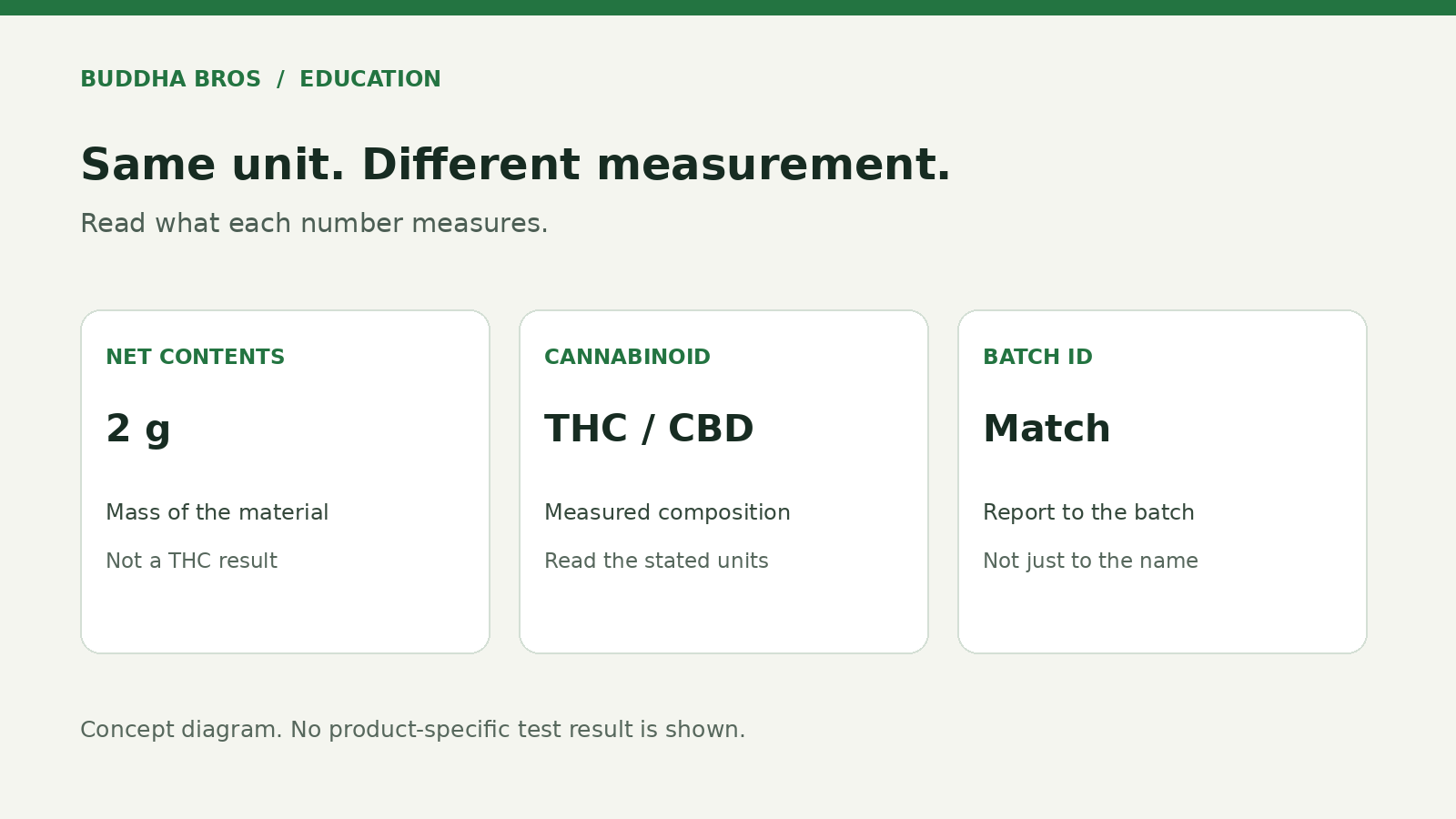
No. Two grams equal 2,000 milligrams of material, but that does not establish 2,000 milligrams of THC. The substance being measured matters as much as the unit. A net-weight statement, a cannabinoid result and a package count answer different questions. This guide explains how to keep those measurements separate.
What does 2 g describe on a cannabis label?
When 2 g is explicitly identified as net contents, it describes the mass of the material inside. It does not describe the mass of the empty container. A product name containing 2 g is less informative than the complete package label: first identify what the number measures and which item or package it refers to.
Sources: California DCC: Manufactured-product labeling checklist
Is 2 g the same as 2,000 mg of THC?
The unit conversion is correct: 2 g equals 2,000 mg. The conclusion about THC is not. If the number refers to the whole preparation, it includes everything in that preparation, not only one cannabinoid. Converting units changes how an amount is written; it does not identify the substance or establish its composition.
Sources: California DCC: Manufactured-product labeling checklist
How does a THC percentage differ from a weight?
A percentage is a proportion. A weight is an amount. Health Canada describes THC potency as a concentration or strength, commonly expressed as a percentage. Consequently, two items with the same net weight need not have the same cannabinoid content. Read the cannabinoid field and its units rather than treating the largest printed number as the potency.
Why do some labels distinguish a package from a serving?
A package can contain more than one labelled serving. California's manufactured-product guidance distinguishes cannabinoid amounts for the entire package from amounts per serving where serving sizes are designated. These are different reporting bases. A package total should not be read as a serving amount, and a labelled serving is not a personalized medical recommendation.
Sources: California DCC: Manufactured-product labeling checklist
Does a pre-roll's weight tell you its THC content?
A pre-roll's net weight describes material, not a laboratory measurement of THC. California's non-manufactured labeling checklist lists net weight separately from cannabinoid information. Product form also matters: an infused preparation cannot be assumed to have the same composition as plain flower simply because both show the same weight. This is a label-reading distinction, not a preparation guide.
Sources: California DCC: Non-manufactured-product labeling checklist · California DCC: Manufactured-product labeling checklist
Which document can clarify the measured cannabinoid content?
A certificate of analysis reports testing for a particular batch. California's laboratory guidance describes cannabinoid testing and contaminant checks, including pesticides, heavy metals and residual solvents. The batch identity matters: a report belonging to another batch is not evidence of this batch's results. Our related label guide explains the distinction between a product name and a batch reference.
Sources: California DCC: Testing laboratories and certificates of analysis
Does a bigger weight or higher THC number establish safety?
No. Neither number is an individual safety assessment. CDC reports that high THC concentrations can increase intoxicating effects and the risk of overconsumption. Questions about medication interactions, symptoms or suitability need a qualified clinician's assessment. This article explains label terminology and does not recommend a dose, device or method of use.
Sources: CDC: Cannabis use disorder and increased THC concentration